
If you are being hurt and feel that you are in immediate danger, call 911!
If you would like to speak to the Domestic Violence Coordinator, call (804) 501-5732. If no one answers, leave a message and the Domestic Violence Coordinator will return your call. You may also email the Domestic Violence Coordinator at [email protected].
What is domestic violence?
Domestic violence is a pattern of behaviors used by one person in a relationship to control the other person in the relationship. Domestic violence can occur between intimate partners or family members. Certain forms of violence may be criminal.
Some examples of domestic violence include:
- Name calling, insulting, or blaming a partner or family member
- Preventing a partner or family member from communicating with or visiting family or friends
- Controlling a partner’s daily activities including where they can and cannot go
- Stalking activities
- Sending numerous messages, calling repeatedly or sending unwanted gifts or letters
- Harassing a partner at their workplace
- Using tracking devices, monitoring a partner’s social media, using a partner’s passwords to access their accounts
- Showing up uninvited after being told not to
- Breaking or damaging a partner or family member’s property or belongings
- Destroying immigration papers or threatening to deport a partner
- Preventing a partner from getting or keeping a job or from attending school
- Withholding money, controlling financial assets, or damaging a partner’s credit score
- Forcing a partner to have sex with others, engaging in sexual activity without consent, coercing sexual activity, sabotaging birth control, sexual assault
- Physically keeping someone from leaving by blocking a doorway, hiding car keys, disabling a car, or locking them into a room
- Physical assault such as strangulation, punching, pushing, slapping, spitting, kicking, or biting
- Using weapons, including objects, to threaten or hurt a partner or family member
- Forcing a partner or family member to take drugs or alcohol
- Refusing to provide medical care or stealing prescription medication
- Deliberately preventing a partner from sleeping
- Using intimidation tactics
- Threatening or harming pets or using them to control family members
Strangulation and suffocation
Strangulation and suffocation are felony crimes in Virginia. Medical attention is essential if you have experienced these crimes. According to the Training Institute on Strangulation Prevention, nearly four in five victims of strangulation are strangled manually (with a body part). Almost all, or 97% of strangulation attempts, also involve physically assault.
There are many myths associated with strangulation and suffocation. Henrico County Police Division Detective Alex Kunz sat down with Bon Secours Violence Response Team Forensic Nurse Betsy Vick to address some of the most common misconceptions surround this topic.
Anyone can be a victim
Victims can be of any age, race, culture, education, sex, religion, employment, or relationship status.
Child Abuse
Children and pets in homes where abuse exists are more likely to be abused and/or neglected. Even if children are not physically harmed, they may have emotional and behavioral problems. Child Protective Services (CPS) operates under the Virginia Department of Social Services (VDSS) and has the responsibility under Section 63.2-1500, et seq of the Code of Virginia to:
- Receive reports of suspected child abuse or neglect;
- Respond to valid reports of suspected child maltreatment;
- Evaluate child safety;
- Support & strengthen families; and,
- Facilitate services to families to help ensure the safety of their children & prevent future abuse or neglect.
Elder Abuse
We are all aging, and it is imperative we reside in safe, helpful, and healthy communities. Unfortunately, elder abuse can come in many forms. The resources at Safety Connector offer information on elder abuse, neglect and exploitation while also provide information about safe and supportive connections for you and the people you care about.
Henrico County Adult Protective Services investigates reports of abuse, neglect, and exploitation of adults aged 60 and over and incapacitated adults over 18 years of age. The goal of APS is to protect a vulnerable adult’s life, health, and property without a loss of liberty.
Learn more about the signs of elder abuse.
Resources
Domestic Violence Blog
Are you asking AI chatbots for dating advice or relationship guidance?
According to a recent study, the AI chatbot you are using might be flattering you with affirmations and validation instead of providing you with sound advice. In comparison to human crowdsourced advice, researchers discovered that chatbots took a users’ perception in interpersonal conflicts nearly 50% of the time even when the user admitted to fibbing or breaking the law. Chatbots reduce a user’s motivation to take accountability for their actions, form healthy attachments, and amend interpersonal conflict. This allows for maladaptive thoughts, feelings, and behaviors to be reinforced. And if you are a teenager or young adult who is new to learning how to navigate social skills for forming and maintaining intimate partner relationships, chatbot advice may be causing more harm than good.
Cyber-psychologist, Dr. Rachel Wood has a few suggestions when asking for advice from AI chatbots. Consider asking chatbots to give you three or four ideas to a situation instead of a single response. This allows you to decide which feels more authentic to you. AI can also be asked to give pros and cons of a situation, perspectives on what another person might be thinking and to challenge your understanding of a circumstance. Afterall, isn’t the intent of pursuing guidance to discover differing viewpoints and to confront biases that allow us to construct informed decisions?
Outsourcing relationship quandaries repeatedly means avoiding the opportunity to develop skills necessary for connecting and maintaining relationships with others such as making moral determinations and displaying empathy. It is important to build human relationship skills. Your mate wants to get to know the authentic you, not a chatbot! Healthy relationships are built between human beings who can hug, share quiet moments with you, offer a shoulder to cry on, empathize, and recount a time when they went through a breakup.
How to safely intervene during a domestic-related situation
You only have a few seconds to intervene, but you hesitate. This happens to many of us when we witness a situation we believe might be domestic violence. Often, we talk ourselves out of intervening due to a fear of embarrassment or endangering ourselves, or we second guess our perceptions. However, there are possible ways to intervene if you think you are witnessing domestic violence in a public place.
- Contact Police. If you witness domestic violence occurring call 911. Witnessing domestic violence means that you are seeing an altercation occur or overhearing one that is actively occurring.
- Group Intervention. You might not feel comfortable approaching the couple on your own. Ask an employee or another citizen if they will approach the couple with you to ask if help is needed.
- Provide Diversion. This may be one way to help the situation you are witnessing from intensifying further. There are a few ways to provide potential diversions.
If you feel it is safe, consider letting the person using abusive behavior know that you are present. This can be accomplished by turning up the radio in your car, placing a real or fake conversation on your cell phone about what you are witnessing, or coughing loudly or something else that lets the couple know that you are close by and a witness to what is occurring.
Again, if you feel it is safe, consider striking up a conversation with the person you are concerned about by asking if they have the time, acting like you are old friends, or asking them where they got their clothes from. This may help to deescalate the conflict or allow you to safely separate the person you are concerned about by asking if you can talk to them away from the other person. Ask them if they need help, briefly share your concern, listen to them, and let them know there are confidential 24-hour helplines available for them to talk about what they are going through. Safe Harbor operates one of these helplines; the phone number is (804) 500-2755.
The reality is, if domestic violence is going to stop, we need to help and support victims who are often unable to speak out for themselves. Using caution is essential when choosing to approach a suspected domestic violence situation. It is safest to approach only when there are other people around, when you do not see or suspect a weapon is involved, and you feel that it is safe for you to do so. Your comfort level is of upmost importance when determining how to best intervene. Remember, even if your attempts are not welcome, leaving an abusive relationship is often a process and not a single event. A person knowing that someone else is concerned about their well-being could go a long way.
What to do
Do you think you are being abused? Do you know a friend, co-worker, neighbor, or family member who is being abused? Do you think you are abusive, or do you know a person who is abusive?
If you have been the victim of a crime or have witnessed a crime, your participation in the criminal justice process is important.
The Henrico County Commonwealth’s Attorney’s Office has a Victim Witness Assistance Program to help you deal with the complexities of our criminal justice system. The staff of this program will advise you of your rights, inform you of the status of your case, and let you know what resources are available to help you.
Access the links below for assistance and information
- Henrico County Resources for Domestic Violence Information and Assistance
- Henrico County Community Resource List (updated Dec. 2025)
- Love is Respect: Resources to disrupt and prevent unhealthy relationships and intimate partners violence by empowering young people through inclusive and equitable education, support and resources.
- Stalking is a dangerous and frequently misunderstood crime that poses unique risks to victims and to communities. A Handbook for Stalking Victims and a Stalking Incident and Behavior Log are available in Arabic, Burmese, Chinese, English, Japanese, Korean, Portuguese, Spanish, Tagalog, and Vietnamese.
- Federal & State Firearms Laws for Domestic Violence Offenders:
- File/obtain a report with the Henrico County Police Division
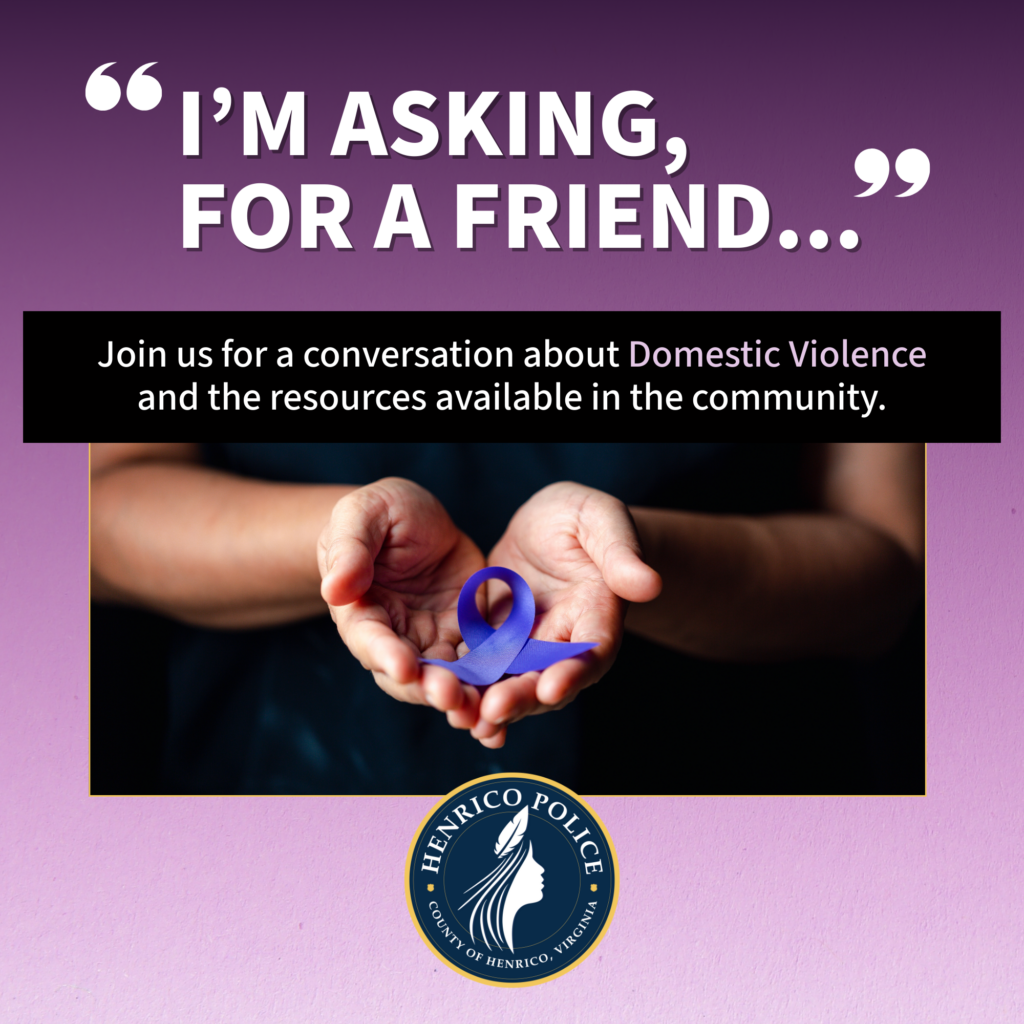
“I’m Asking, For a Friend…”
The Henrico Police Division’s Domestic Violence Coordinator hosts the “I’m Asking for a Friend…” podcast. This podcast features survivors, officers, advocates, and other experts having conversations about domestic violence and related matters. We hope listening will lead to the start of more conversations, and safer and healthier relationships.