Geo Coordinates
37.422513, -77.298523
Description
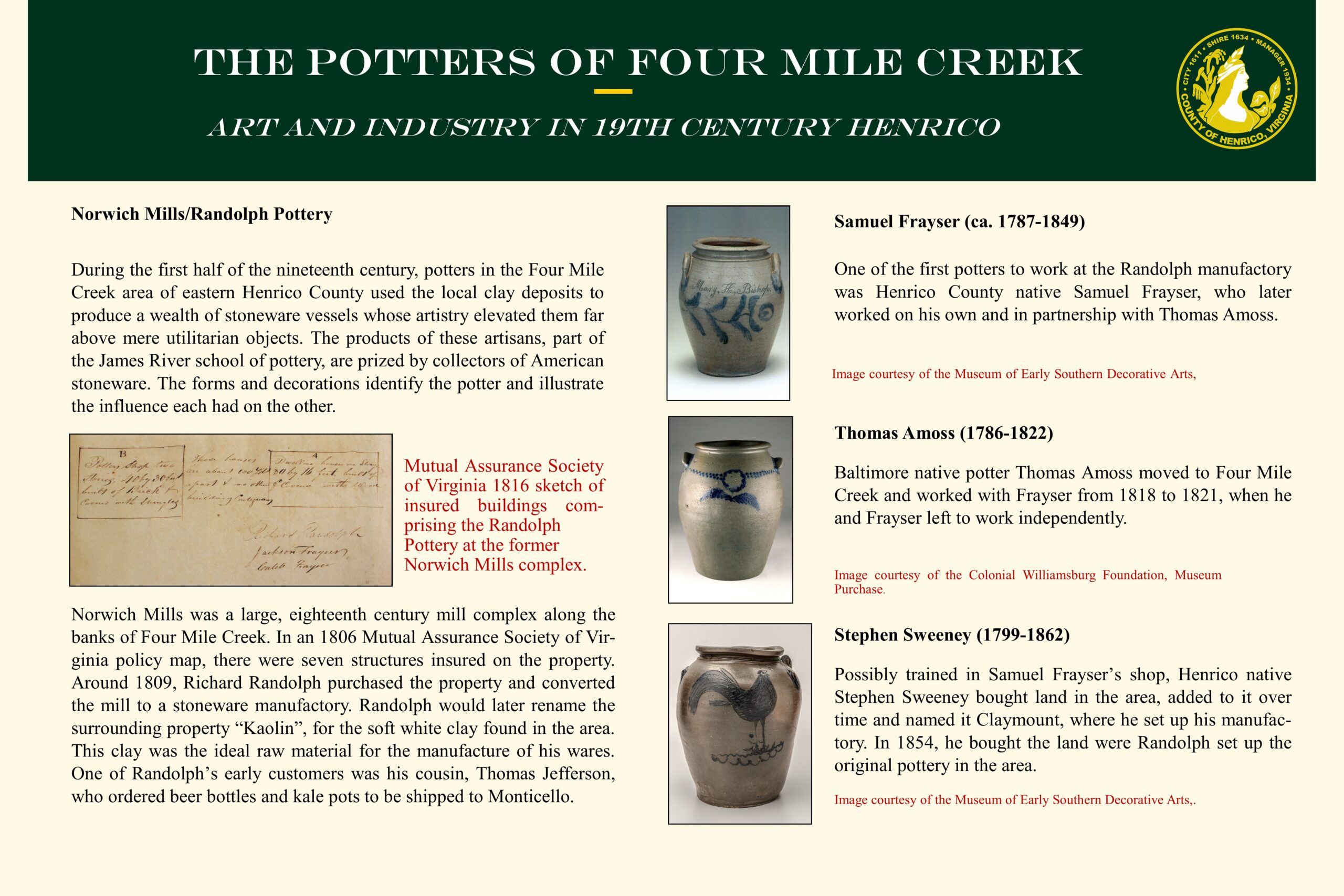
Art and Industry in 19th Century Henrico
Norwich Mills/Randolph Pottery
During the first half of the nineteenth century, potters in the Four Mile Creek of eastern Henrico County used the local clay deposits to produce a wealth of stoneware vessels whose artistry elevated them far above mere utilitarian objects. The products of these artisans, part of the James River school of pottery, are prized by collectors of American stoneware. The forms and decorations identify the potter and illustrate the influence each had on the other.
Norwich Mills was a large, eightteenth century mill complex along the banks of Four Mile Creek. In an 1806 Mutual Assurance Society of Virginia policy map, there were seven structures insured on the property. Around 1809, Richard Randolph purchased the property and converted the mill to a stoneware manufactory. Randolph would later rename the surrounding property “Kaolin”, for the soft white clay found in the area. This clay was the ideal raw material for manufacture of his wares. One of Randolph’s early customers was his cousin, Thomas Jefferson, who ordered beer bottles and kale pots to be shipped to Monticello.
Samuel Frayser (ca. 1787-1849)
One of the first potters to work at the Randolph manufactory was Henrico County native Samuel Frayser, who later worked on his own and in partnership with Thomas Amoss.
Thomas Amoss (1786-1822)
Baltimore native potter Thomas Amoss moved to Four Mile Creek and worked with Frayser from 1818 to 1821, when he and Frayser left to work independently.
Stephen Sweeney (1799-1862)
Possibly trained in Samuel Frayser’s shop, Henrico native Stephen Sweeney bought land in the area, added to it over time and named it Claymount, where he set up his manufactory. In 1854, he bought the land were Randolph set up the original pottery in the area.