
VA250 commemorates the 250th anniversary of the American Revolution, the Revolutionary War, and US Independence in the Commonwealth of Virginia.
Henrico County’s VA250 committee is part of these larger state and national efforts to recognize the people and events of the American colonies fight for independence and its founding through an ongoing series of programs, events, and projects.
While state and federal efforts may peak in 2026, Henrico County will continue offering a variety of ways to learn about the people and events of the past as well as to engage in dialogue on what liberty, freedom, and how the legacy of events 250 years ago shape the present and what our citizens hope to see for the future.
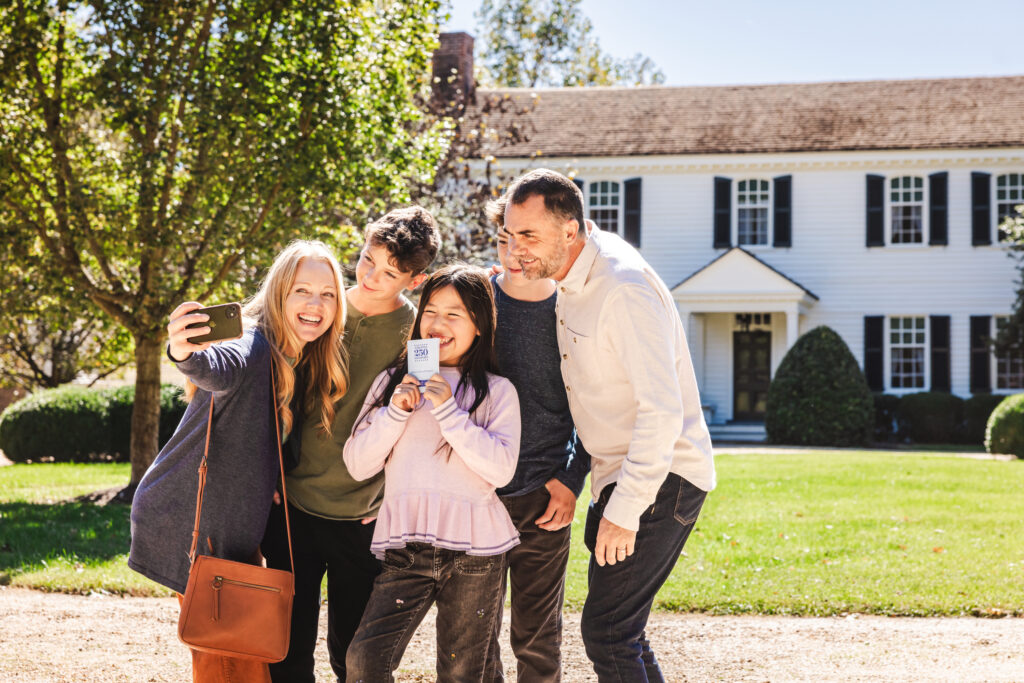
Virginia 250 Passport
The Virginia 250 Passport is the first-of-its-kind and it’s a statewide tourism journey celebrating America’s 250th anniversary – encouraging individuals and families to explore and experience history together. 70 premier historic destinations in Virginia are participating, including our very own Meadow Farm Museum.
More information about the program is available at VirginiaHistory.org/250Passport.
250 Programs
Revolutionary Vaccines
Sun, Sep 12, 2-3pm. Eastern Henrico Rec Center.
Did you know that George Washington organized the first mass military immunization in US history? Learn more about the major milestones in vaccine development and the global drivers behind those breakthroughs. Information: [email protected]
The Oneida Nation and the American Revolution
Sun, Sep 20, 2-3pm. Eastern Henrico Rec Center.
Discover the role of the Oneida Nation Indians in the American Revolution. In particular, we will highlight the roles of Polly Cooper and Two Kettles Together (Tyonajanegen). Information: [email protected]
The Turtle: The Revolution Under the Waves
Sun, Sep 27, 2-3:30pm. Belmont Rec Center.
Ages 10+. One of the many problems for the American forces during the American Revolution was the British Navy, at the time the world’s largest and most powerful navy in the world. David Bushnell’s solution: The Turtle, the first operational armed submarine. Discover more about this early attempt at undersea warfare at this lecture with naval historian Ed Moore from the Mariner’s Museum. Information: [email protected]
Phillis Wheatley and Her Legacy
Sun, Oct 4, 2-3pm. Eastern Henrico Rec Center.
Discover more about the remarkable life and legacy of the poet laureate of the American Revolution, Phillis Wheatley. Information: [email protected]
London Pleasants: From Enslaved to Redcoat
Wed, Nov 4, 6-7pm. Parsons Community Center.
Ages 10+. Follow the life of London Pleasants from enslavement to self-emancipation in Henrico County. Learn about his time as a Black Loyalist and fate after the American Revolution. Information: [email protected]
Movie in the Park: Hamilton
Fri, Nov 6, 6:30-9:30pm. Meadow Farm.
Don’t throw away your shot to see Hamilton: An American Musical for free! The VA250 Mobile Museum will be here so check it out before the movie begins. Bring a blanket or chair along with friends and family! Picnics are welcome and movie begins at 6:30pm. Information: [email protected]
1776: Signing Day
Sat, Nov 7, 1-4pm. Meadow Farm.
It’s 1776, and the fate of the colonies hangs in the balance. Will you join those signing their names for independence, or remain faithful to the King? Discover the arguments, challenges, and choices that led ordinary Virginians to take sides during the American Revolution. Witness musket firing, learn about the life of soldiers, listen to music of the era, and play games from 250 years ago. Information: [email protected]
Hamiltrivia
Sun, Nov 8, 2-3pm. Parsons Comm Center.
Do you know your Maria Reynolds from your Peggy Schuylers? Find out in our new trivia game where we will test your knowledge of the hit musical versus the real life of Alexander Hamilton. Information: [email protected]
Art in the Park
In honor of the 250th, as a department, we sought and were awarded a grant through Virginia Tech and the Virginia Association of Museums (VAM) Public Exhibitions, Displays, Art, and Logos (PEDAL) program. This initiative awarded us funds for an exhibit to call attention to regional and local features along the Bike 76 trail, which runs through Henrico County. The Bike 76 trail was created in 1976 for the nation’s bicentennial and has effectively been known as “Bikecentennial!”
The site chosen for this exhibit was Four Mile Creek, the Capital Bike Trail’s busiest trailhead out in Varina on New Market Road (Route 5). For a number of reasons, it was important to engage in this park. First, because of the large user group there. Second, it is a county park which has a history of Revolutionary War. Third, there is proximity access to interstate 295. Lastly, but most important, this park is closely located to heavy American Revolution activity, and a lot of stories of the area. One of the most prominent stories comes after the war, the landmark Pleasants v. Pleasants court case of 1799 in which Robert Pleasants took his family members to court to honor the stipulations of his father John Pleasants’ will of 1771, stipulating that his enslaved workers be freed upon his death. The resulting verdict resulted in the creation of the free black community of Gravel Hill.
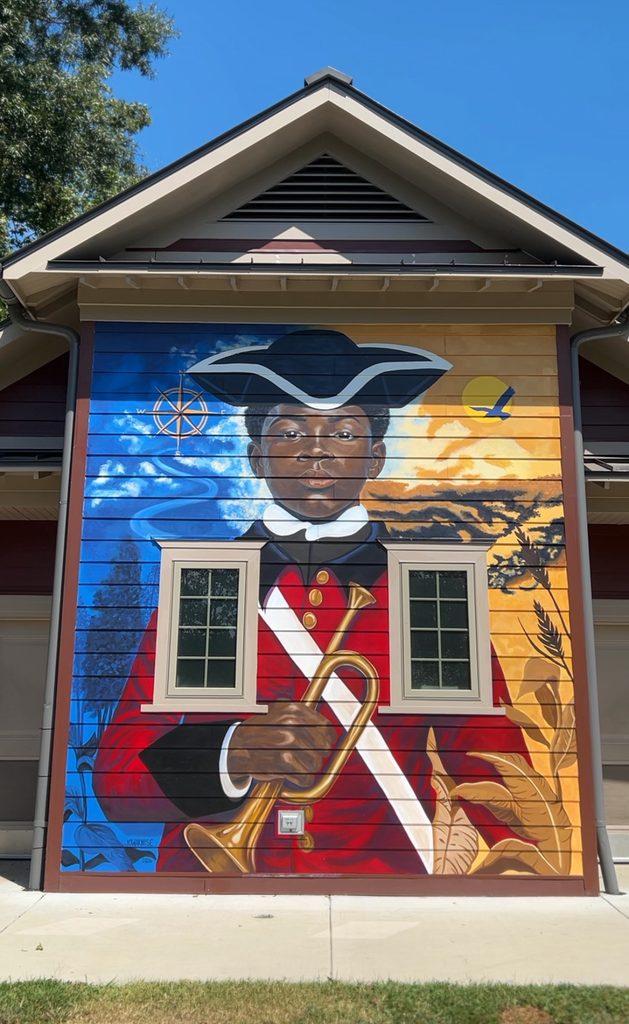
But a story that is closely linked to the Pleasants family is probably one you haven’t heard before. In January 1781, Benedict Arnold (yes, that Benedict Arnold) crossed through Henrico County headed for Richmond, trying to capture Governor Thomas Jefferson. Along the way, Arnold’s troops raided Pleasants’ Curles Neck Plantation, and in addition to supplies, Arnold also gained more troops from Pleasants enslaved population. Among them was 14-year-old London, enslaved to Robert Pleasants. London self-emancipated from the Pleasants family, enlisting to Arnold’s “American Legion,” an entire battalion of American-born loyalists joining the “winning side.” London served as a trumpeter, no doubt signaling troop maneuvers, marching orders, general orders, and such. London would serve alongside Arnold’s division through the end of the war, being noted in New York City on September 18, 1783, boarding the ship Elizabeth bound for St. John’s (Newfoundland). So London found his own route to freedom.
Yet London’s story in Henrico County is being brought back to the forefront through a public mural at Four Mile Creek, adding to the amenities of the park, and giving those who aren’t riding bicycles “cause to pause” and stop in to visit the park. After receiving numerous proposals from a number of local artists, we selected Jowarnise Caston as the muralist. The mural is complete and ready for all to admire.
VA250 Mobile Museum
Nov 4-6: 2-5pm. Nov 7: 1-4pm. Meadow Farm Museum.
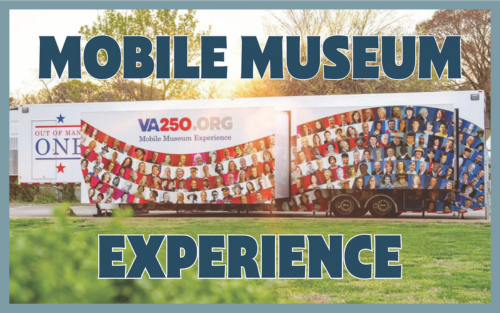
VA250 Mobile Museum Experience, “Out of Many, One,” will visit Meadow Farm Museum in Henrico County from Wednesday, November 4 through Saturday, November 7 to share with the community Virginia’s foundational role in the birth of the nation. The high-tech, interactive museum on wheels will be open throughout the weekend to coincide with events included in Henrico’s annual 250th events. Information: [email protected]
Sign up for the monthly newsletter!
These are just the VA250 programs— to learn more about all of the history happenings, get on our mailing list. You can also view upcoming history programs on this site.

Timeline
| Date | Historical Event |
|---|---|
| 1752 | Henrico County’s courthouse moves from Varina to Richmond in the middle of East Main and 22nd streets. |
| May 1752 | Reverend William Stith, of Henrico, makes one of the earliest public protests on taxation without representation, protesting Royal Governor Dinwiddie’s policy of charging one Spanish pistole to place his official seal on land patents without the consent of the Virginia Assembly. |
| May 31, 1767 | British chancellor of the Exchequer Charles Townshend introduces in the House of Commons his program to tax the colonies. |
| April 2, 1768 | Henrico residents send a petition to the House of Burgesses claiming that the Townshend Act taxes infringe on the rights of free citizens. 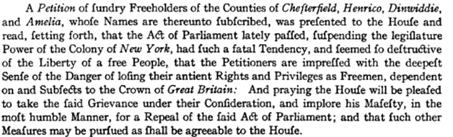 Journals of the House of Burgesses of Virginia, 1766-1769, pg 145 (Sat, the 2nd of April. 8 Geo. III. 1768) |
| July 27, 1769 | Anne Randolph (Wilton) and Lucy Randolph (Chatsworth) have their names in the Virginia Gazette signing nonimportation pacts. |
| May 1769 | Governor Boteourt dissolves the House of Burgesses due to their protests. |
| Dec 14, 1769 | Over 100 women wear homespun gowns to a ball in Williamsburg to protest British tax policy. |
| May 24, 1774 | Virginia House of Burgesses declares a day of prayer and fasting to protest British taxes. |
| July 28, 1774 | The Virginia Gazette publishes the Henrico Resolves in support of the Massachusetts colony and in response to Parliament’s creation of the Coercive Acts, also referred to as the Intolerable acts in the colonies.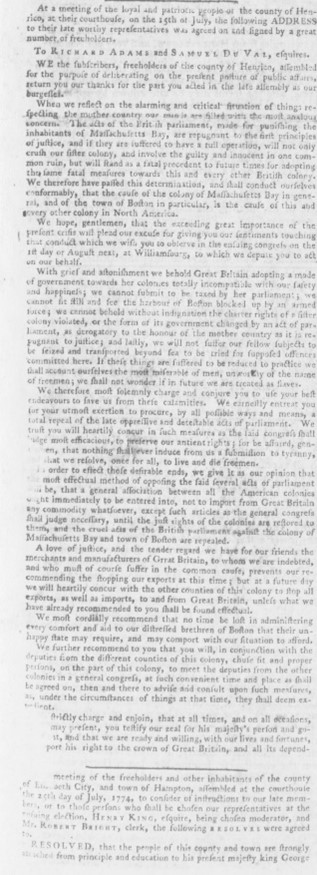 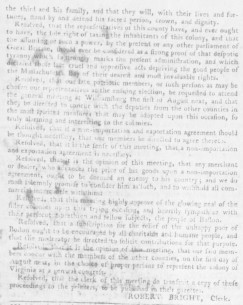 |
| Aug 1, 1774 | First Virginia Convention in Williamsburg convenes with Richard Adams and Samuel DuVall representing Henrico. |
| Nov 17, 1774 | Henricoans gather at the courthouse based on agreements set by Continental Congress earlier that fall to elect a county committee “to observe the conduct of all persons touching this association” and publish information on individuals violating it. |
| Mar 20, 1775 | Second Virginia Convention convenes at St. John’s Church. Reverand Miles Seldon of Henrico is appointed chaplain and Henrico again is represented by Richard Adams and Samuel DuVal. |
| Mar 23, 1775 | Patrick Henry delivers “Give Me Liberty or Give Me Death” speech. |
| Mar 25, 1775 | George Washington visits Anne Randolph at Wilton Plantation in eastern Henrico after attending the Second Virginia Convention. |
| Apr 21, 1775 | Governor Dunmore orders the seizure of gunpowder stored in the public magazine at Williamsburg. |
| Apr 26, 1775 | The Henrico committee responds to the seizure of gunpower, claiming that removing the gunpowder was “an insult to every freeman in this country.” |
| Jun 14, 1775 | The Second Continental Congress establishes the Continental Army and elects George Washington its commander the following day. |
| July 17, 1775 | The Third Virginia Convention meets at St. John’s Church with Richard Adams and Richard Randolph representing Henrico. |
| Nov 6, 1775 | Henrico elects 21 men to a committee to enact measures adopted by Continental Congress, Va Convention & Committee of Safety. |
| Nov 7, 1775 | John Murray, the Earl of Dunmore and Virginia’s royal governor, issues a proclamation to free enslaved and indentured servants able and willing to serve in the British army. |
| Nov 1775 | Lord Dunmore’s Ethiopian regiment forms, providing military training and arms for the first Black military unit raised by the British in North America. |
| Dec 1775 | Armed men raid homes in Henrico County stealing salt, a valuable food preservative.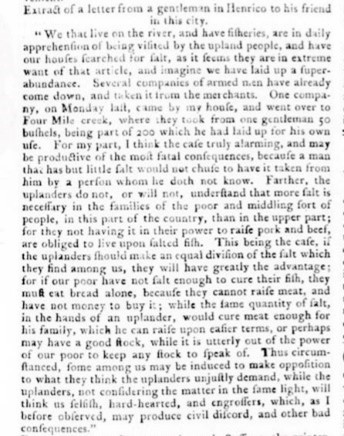 |
| Dec 1-10, 1775 | One company of the Henrico Battalion activate into service (led by Captain William DuVal) at Williamsburg. They remain there until discharged on March 6, 1776. |
| Dec 9, 1775 | Battle of Great Bridge in Norfolk County results in an American victory. |
| Dec 28, 1775 | 5th Virginia Infantry Regiment forms in Richmond partially consisting of troops from Henrico. |
| Feb 1776 | Henrico conducts a survey of residents and reports 500 men of military age in the county. |
| Feb 24, 1776 | The 3rd Company of the 5th VA Regiment under Capt. John Pleasants is organized in Henrico County. This regiment will fight at the battles of Trenton, Princeton, NJ; Brandywine and Germantown, PA; Monmouth, NJ; and Charleston, SC. |
| Jun 29, 1776 | The General Assembly elects Patrick Henry as Virginia’s first governor. |
| Aug 5, 1776 | By order, Henrico’s sheriff reads the Declaration of Independence in front of the county courthouse. |
| May 28, 1776 | Robert Pleasants writes to Governor Patrick Henry, requesting those who wish to free their enslaved laborers be allowed to do so. |
| May 12, 1779 | The 5th Virginia, consisting of Henrico soldiers, consolidates into the 3rd Virginia Infantry Regiment. |
| July 12, 1779 | The Virginia Assembly votes to move capital from Williamsburg to Richmond. |
| June 10, 1780 | “Sentiments of an American Woman,” calling on American women to organize and collect donations for Continental Army soldiers, is published. The document becomes the foundation of the Philadelphia Ladies’ Association, as well as a similar voluntary organization in Virginia. Martha Washington serves as the organizations’ chief treasurer, and Virginia women collect over $100,000. |
| Jan 4, 1781 | British General Benedict Arnold leads troops down New Market Road, skirmishes at Chimborazo Hill with local men, then advances to Richmond, burning the town and its supplies. Watch Video |
| Mar 1, 1781 | Maryland ratifies the Articles of Confederation after Virginia agrees to relinquish its western land claims. |
| Apr 27, 1781 | British General Arnold’s troops destroy the entire Virginia State Navy during the Battle of Osborne’s Landing. |
| Apr 30, 1781 | British and American forces exchange artillery fire across the James River, with the British in Manchester and the Americans in Richmond. |
| May 3, 1781 | French aristocrat the Marquis de Lafayette, serving as a Major General in the Continental army, moves troops to Bottoms Bridge in eastern Henrico. |
| May 26, 1781 | British troops under General Cornwallis cross the James River from the south and march over Malvern Hill, moving north to Hanover County. |
| Jun 18-20, 1781 | Cornwallis’s troops march from the west into Richmond, occupy it, and move on toward Williamsburg by way of Bottoms Bridge. |
| Late July 1781 | Lafayette and Virginia militia camp at Malvern Hill for about two weeks. |
| Oct 19, 1781 | The Siege of Yorktown concludes with the British surrendering to Continental and French forces, effectively ending major military operations in Virginia. |
| Oct 10, 1800 | Gabriel, an enslaved laborer from Henrico, is executed after organizing a large-scale slave rebellion. Inspired by revolutionary ideals, he planned to create a flag bearing the words ‘Death or Liberty,’ reflecting his commitment to freedom at any cost. |